Governance, CI & supply-chain security (WP L)
This page documents how Knovaryn is built, tested, released, and governed — the CI / security / supply-chain / release layers (spec WP L). It is the operational counterpart to the hardening and privacy & licensing pages.
Principles
- Fail closed. Any gate that cannot prove a property fails the build or the release. Export refuses on unresolvable lineage; a wheel containing secret-like content is never published.
- No stored secrets for publishing. Releases use OIDC trusted
publishing to PyPI (
id-token: write), so noPYPI_API_TOKENis stored in the repo or Actions secrets. - Explicit, release-gated publishing. Nothing pushes to PyPI / containers /
datasets from a plain
maincommit. Publishing only happens on an explicit GitHub Release tag (vX.Y.Z), and only when the full package CI passed. - Private build process, public product. Build tooling, prompts, and local build/audit artifacts are never committed into the public repo.
CI layers
.github/workflows/ci.yml runs on every push/PR and is organized into isolated
jobs so a failure is attributed to one layer:
| Job | What it enforces |
|---|---|
lint-type |
ruff check + ruff format --check on src tests, mypy src (per-module missing-import overrides only) |
test |
Full offline suite on Python 3.11 / 3.12 / 3.13 (all live/gated tiers excluded) |
test-tiers |
Each tier (unit / integration / mcp / rest / chaos / release) in an isolated job |
coverage |
scripts/coverage_gate.py: ≥75% overall branch on the core packages, ≥80% per critical module (documented exemptions only) |
platform-smoke |
Import + CLI + local-storage smoke on Windows and macOS |
docs |
mkdocs build --strict + markdown link check |
container |
Builds the image on main |
Security scanning
.github/workflows/security.yml runs on every push/PR and weekly:
- gitleaks — leaked-secret detection (SARIF to code scanning).
- pip-audit — vulnerable-dependency audit (fails on known vulnerabilities).
- bandit (
-lll) — static security scan ofsrc. - Trivy — container image, filesystem, and IaC/K8s manifest scans (CRITICAL/HIGH fail the job).
- pip-licenses — license inventory (drives license compliance).
- SBOM — anchore cycloneDX generated from
uv.lock, uploaded as an artifact.
Release / supply-chain pipeline
.github/workflows/publish.yml runs only on a GitHub Release event and
composes the WP L release safeguards:
package-ci— runsscripts/package_ci.py: build wheel + sdist,twine check, metadata verification, wheel secret scan (private keys / access keys / API tokens — any hit fails closed), clean-env install, and CLI / MCP / REST smoke from the installed wheel.tag-version-consistency— thevX.Y.Ztag must equalpyproject.tomlproject.version.ci-gate— the release SHA must have passing CI and security workflows.deploy-e2e— the compose stack runs the image built from the exact published tag.build— rebuilds and uploads thedist/artifact.release-assets— attaches detachedSHA256SUMS, a CycloneDX SBOM from the locked resolution, notes generated fromCHANGELOG.md, and enforces that0.xtags are marked pre-release.publish— uploads to PyPI via OIDC trusted publishing (environment: pypi,id-token: write). Thepypienvironment must be mapped to theknovarynproject in PyPI's trusted-publishers settings.post-publish-verify— a clean environment resolves the just-published version from the public index.
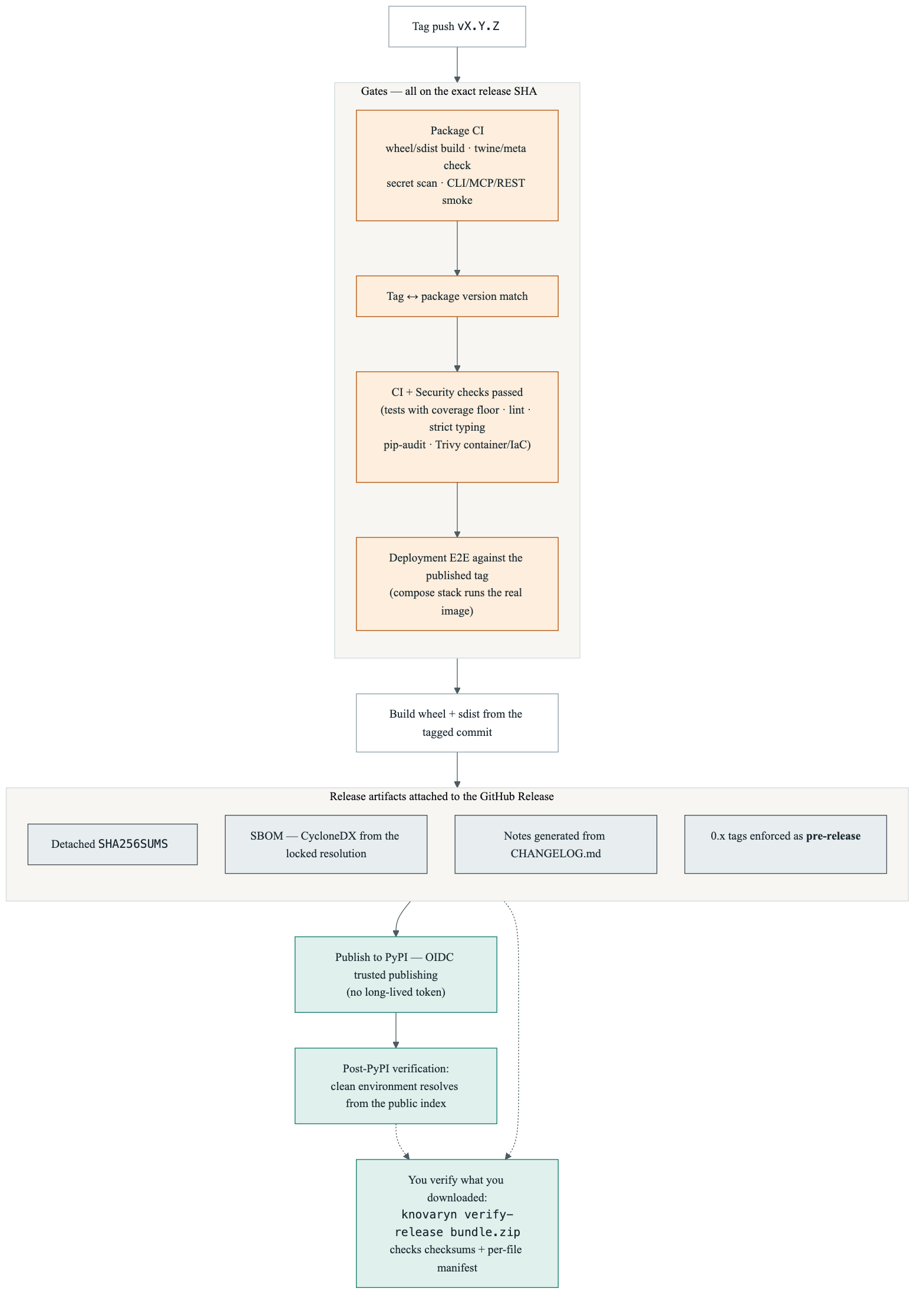
Release artifacts are reproducible: ReleaseBundle uses fixed zip timestamps,
stable sorted file order, JSON sort_keys, and detached .sha256 checksums,
and knovaryn verify-release independently verifies the detached checksum and
per-file manifest.
Governance & dependency hygiene
- Dependabot (
.github/dependabot.yml) opens weekly, capped PRs for Python deps (fromuv.lock) and pinned GitHub Actions. Nothing auto-merges — every bump goes through normal review. - Protected branch on
main: requirelint-type,test,test-tiers,coverage,security, andplatform-smoketo pass before merge; require pull-request reviews; admin not allowed to bypass reviews. - CODEOWNERS (
.github/CODEOWNERS): security-sensitive areas (infrastructure/intake/,infrastructure/auth/,SECURITY.md) always pull in a security-aware reviewer. - Contributing / security process: see
CONTRIBUTING.mdandSECURITY.md. - Vulnerability response: HIGH/CRITICAL findings from any scan are release blockers; a coordinating fix lands through the same gated PR pipeline and is noted in the changelog.