Architecture — Diagram Gallery
Every Knovaryn diagram has a Mermaid source file in the repo — most under
assets/diagrams/,
the README pipeline diagram at assets/pipeline-flow.mmd —
and a deterministic PNG render beside it (assets/*.png), produced by
python scripts/render_diagrams.py. This page embeds those renders with short
commentary; for side-by-side browsing with keyboard-switchable views, use the
architecture explorer.
The source files are canonical — this page never re-states their contents inline, so the prose and the picture cannot drift apart. All diagrams share the design-system palette and are count-free by policy: they say what things are, never how many; the generated reference pages carry live numbers.
1. System architecture — one core, many interfaces
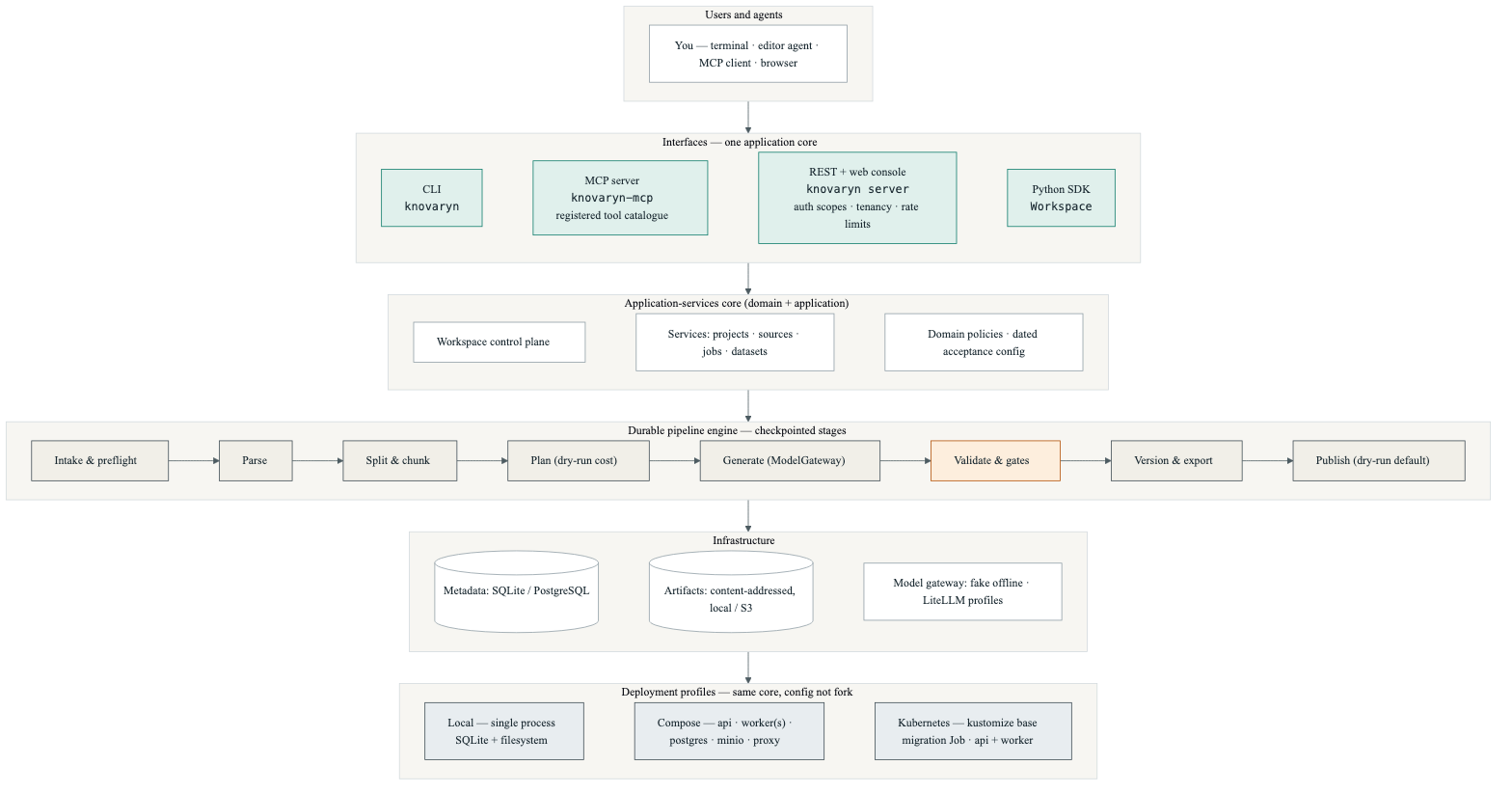
Six layers, top to bottom: the people and agents, the four interfaces (CLI, MCP server, REST + web console, Python SDK), the application-services core, the durable pipeline engine with its eight checkpointed stages, the infrastructure (metadata store, content-addressed artifacts, model gateway), and the three deployment profiles. The layering is the point: every interface drives the same core, so a job started from the CLI is visible everywhere.
Mermaid source · Full-size PNG
2. End-to-end pipeline flow — every example traced to its source
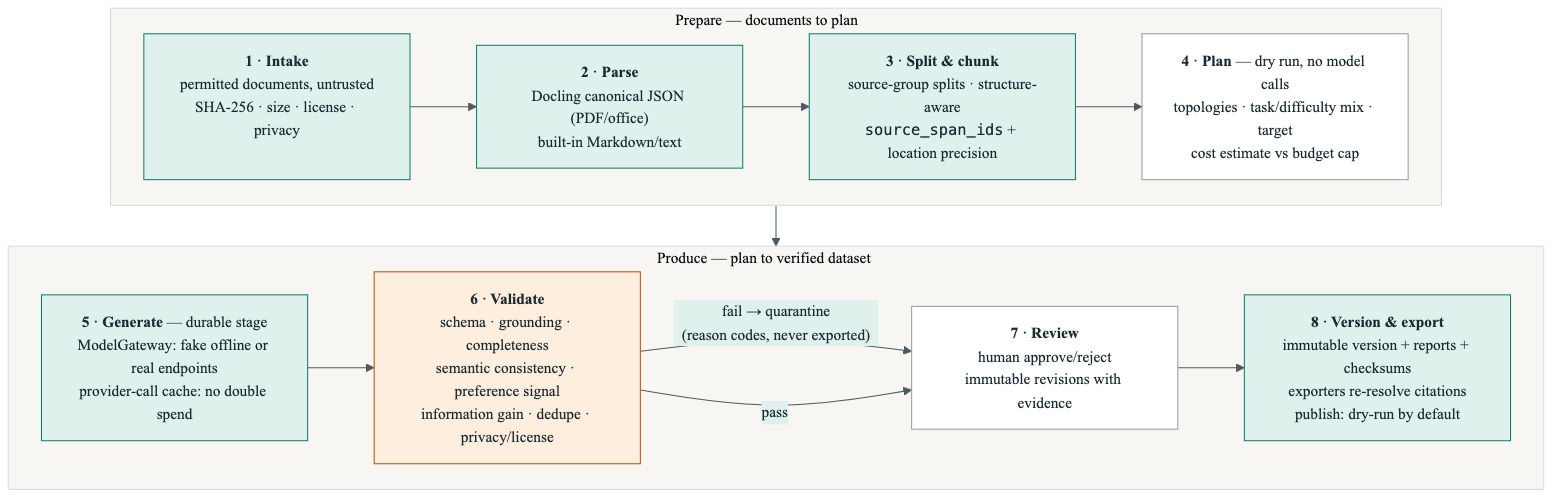
Two rows. Prepare moves a permitted document to a generation plan:
intake preflight (SHA-256, size, license, privacy), parsing to canonical
JSON, structure-aware splitting that records source_span_ids, and a dry-run
plan that prices the run before any model call. Produce executes it:
generation through the model gateway, validation where failures quarantine
with reason codes (and are never exported), human review with immutable
revisions, and versioning/export where citations are re-resolved and
checksums written.
Mermaid source · Full-size PNG
3. Durable jobs — nothing is lost on a crash
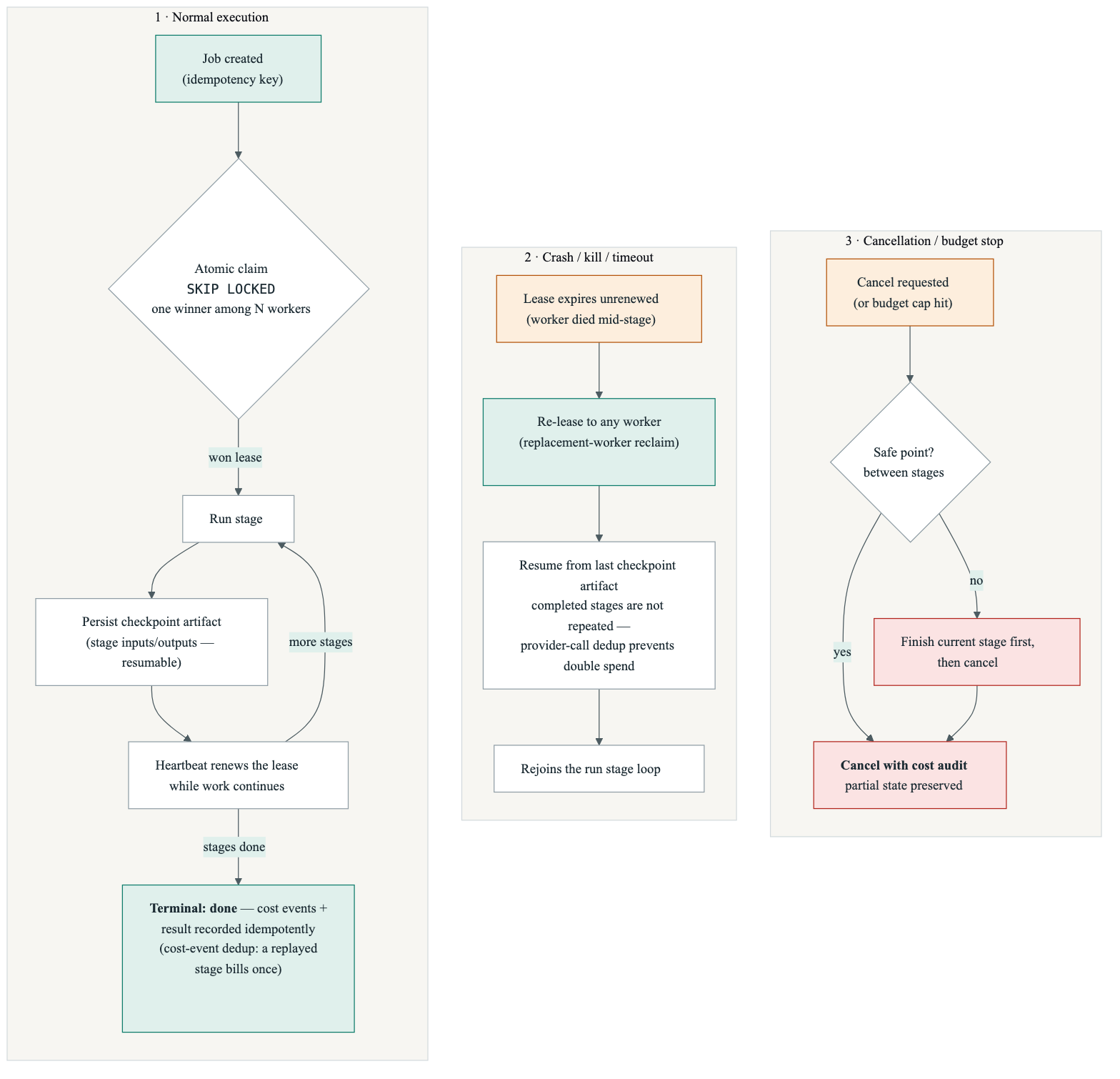
Three lanes. Normal execution claims a job atomically (SKIP LOCKED, one
winner among N workers), checkpoints after every stage, and heartbeats while
it works. The crash lane is what a killed worker triggers: the lease expires
unrenewed, any replacement worker re-leases, and the job resumes from the
last checkpoint — provider-call dedup means completed paid work is never
repeated. The cancellation lane is cooperative: the cancel flag is polled
between stages, never mid-write, and cancellation records a cost audit.
Mermaid source · Full-size PNG
4. A typical MCP agent session
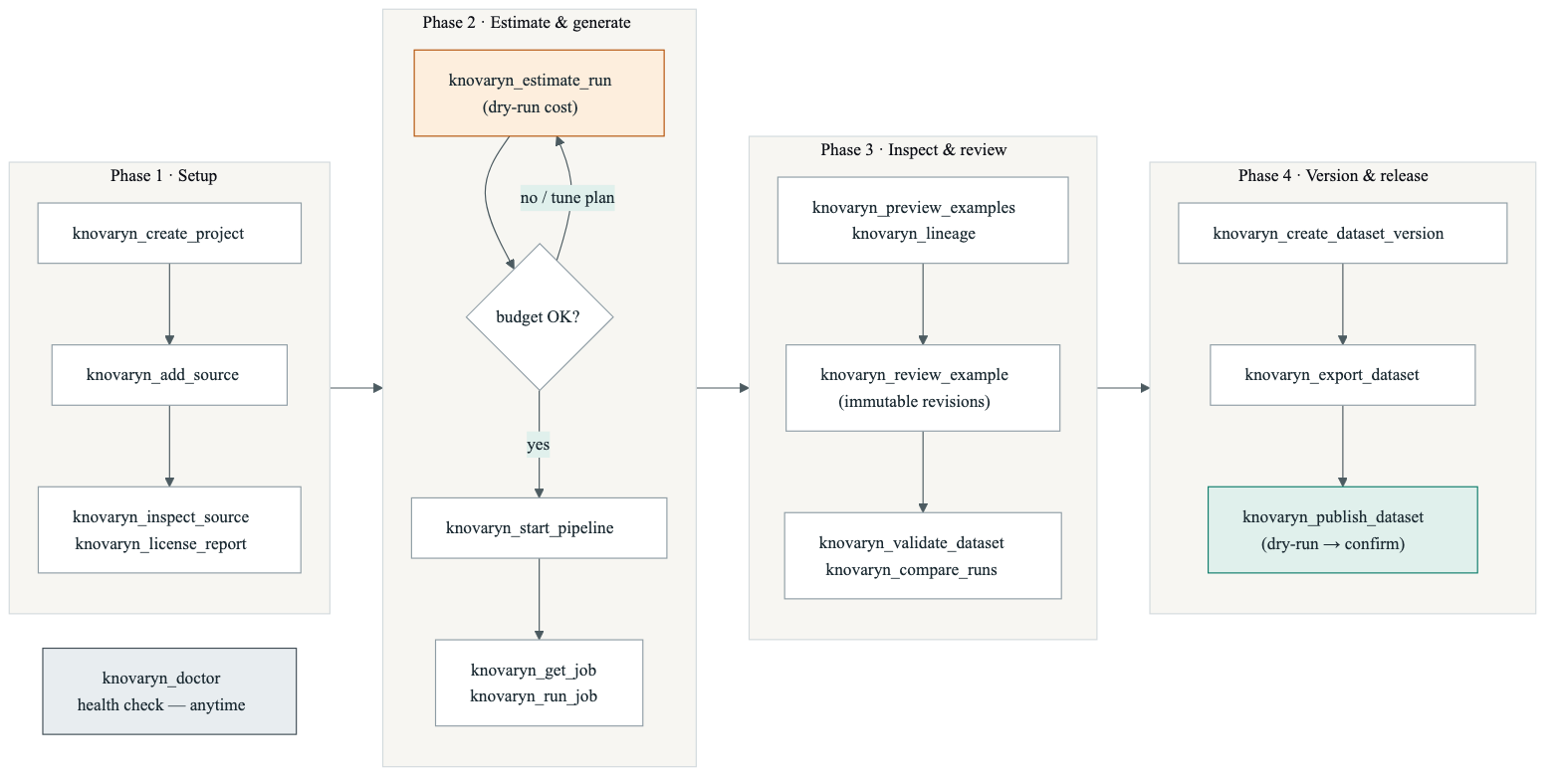
Four phases left to right — setup, estimate & generate, inspect & review,
version & release — each naming the real MCP tools an agent calls. The
estimate step is a deliberate loop: a dry-run cost estimate is compared
against the budget before start_pipeline, and a plan that overshoots goes
back for tuning. knovaryn_doctor sits outside the phases because it is
useful at any point. The full tool catalogue lives on the
MCP tools reference, never in one crowded image.
Mermaid source · Full-size PNG
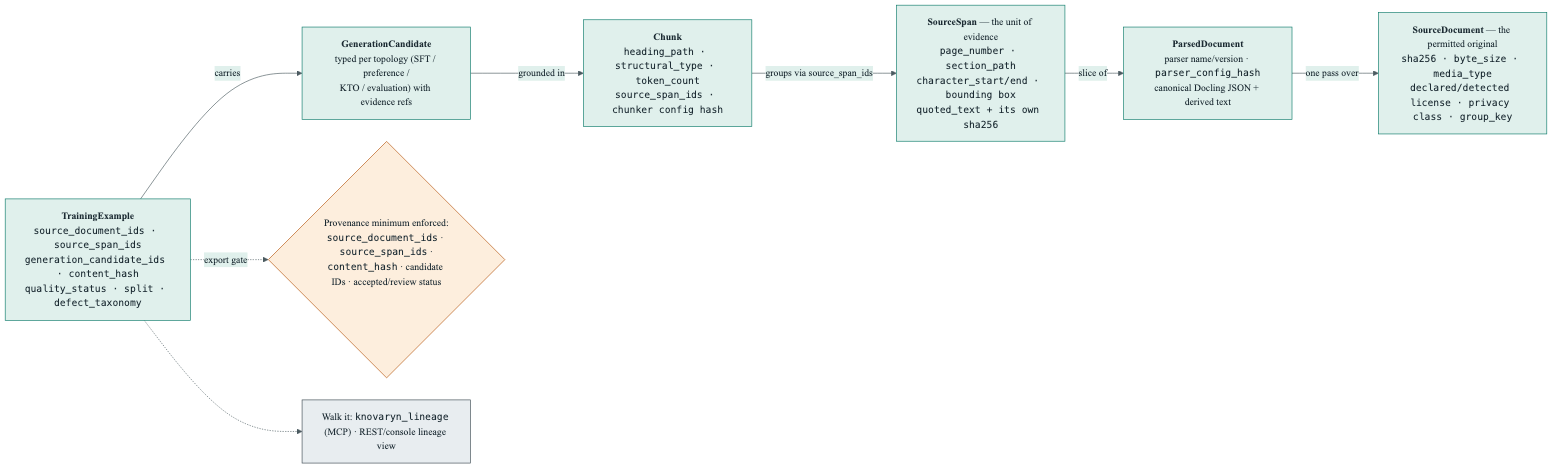
5. Provenance chain — from exported row back to source bytes
Read right to left for the storage direction, left to right for the audit
direction: an exported training example carries generation-candidate and
content-hash identity; it is grounded in source spans that record page,
section path, character offsets, bounding box when available, and the quoted
text with its own SHA-256; spans slice parsed documents, and parsed documents
record which parser configuration produced them; source documents carry the
file hash, license, and privacy classification that intake admitted. The
diamond is the policy: a provenance minimum is enforced, and
knovaryn_lineage walks the whole chain for any example.
Mermaid source · Full-size PNG
6. Security & privacy boundaries
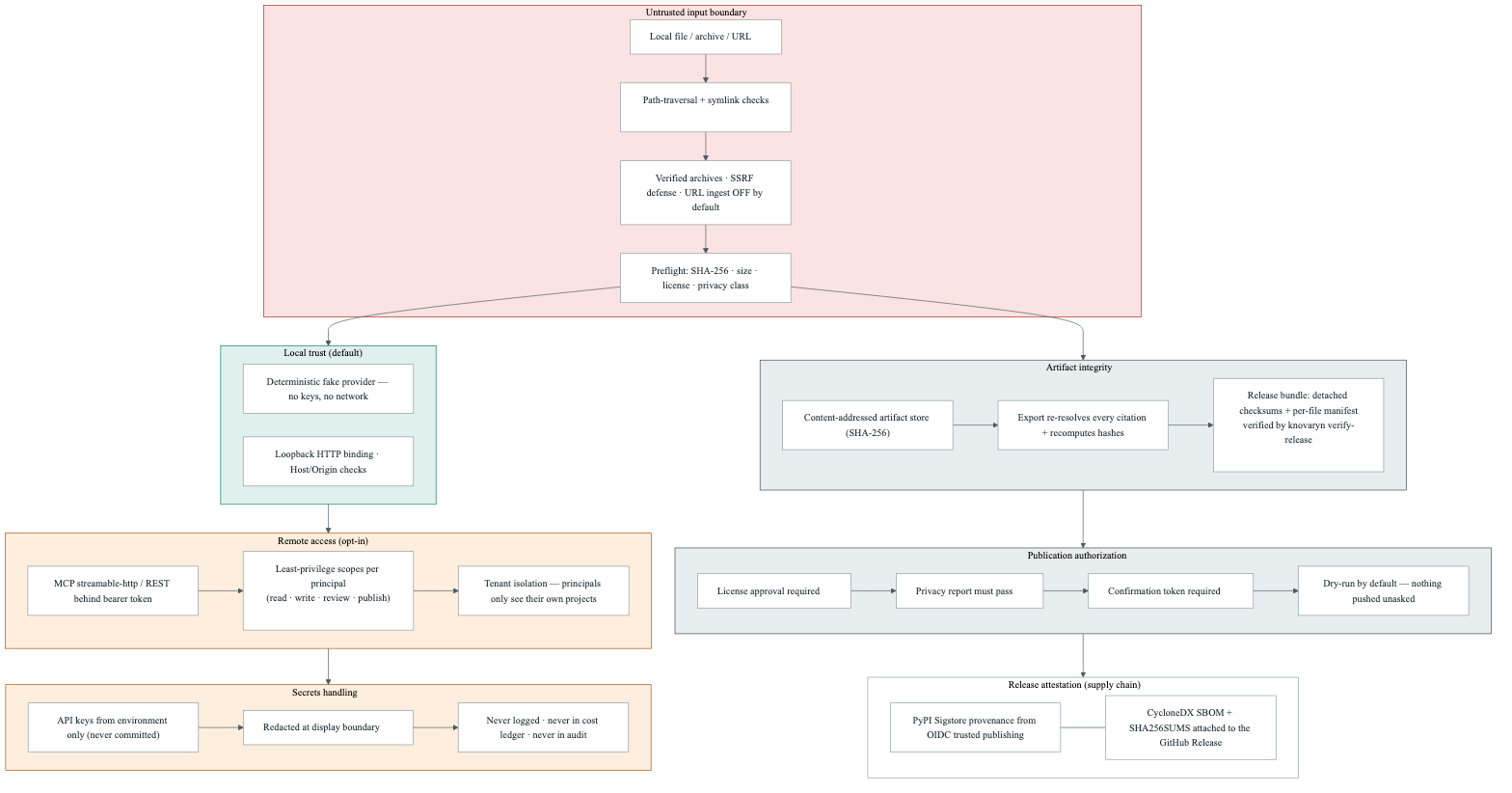
The map is color-coded by trust: the red region is untrusted input, where path-traversal and symlink checks, verified archives, SSRF defense, and URL-ingest-off-by-default run before preflight records hash, size, license, and privacy class. Green is the local default — the deterministic fake provider needs no keys and no network, and servers bind to loopback with Host/Origin checks. Amber is opt-in remote access (bearer token, least-privilege scopes, tenant isolation) and secrets handling (environment only, redacted at the display boundary, never logged). The slate regions are artifact integrity, publication authorization, and the release attestation chain.
Mermaid source · Full-size PNG
7. Deployment topology — same core at three scales
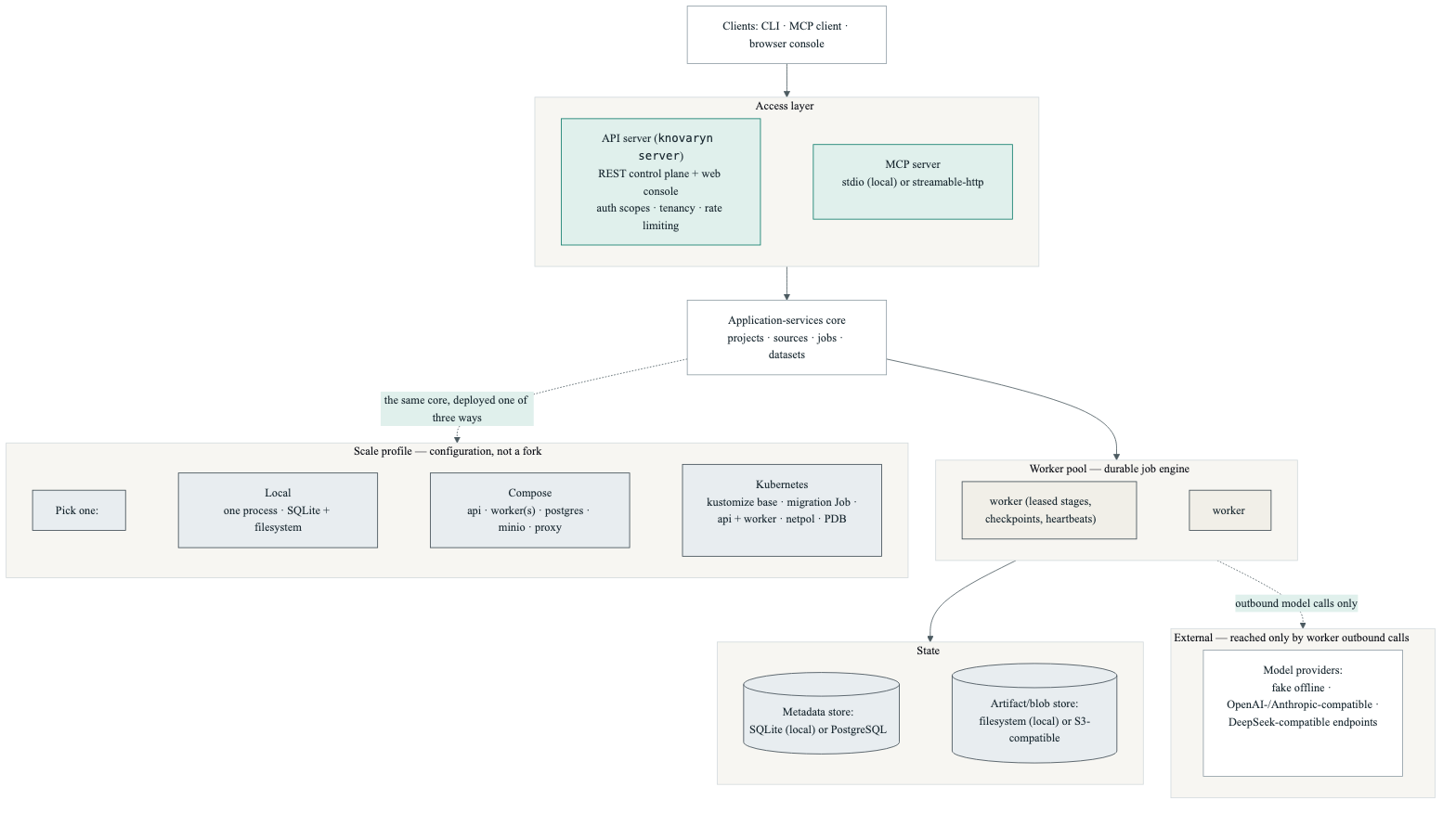
One column is the running system: clients, the access layer (API + MCP server), the application-services core, the worker pool, and the state stores. Model providers sit outside the trust boundary — only workers make outbound calls to them. The bottom row is the scale decision: local single process, compose stack, or Kubernetes — configuration, not a fork.
Mermaid source · Full-size PNG
8. Release supply chain — from tag to verified install
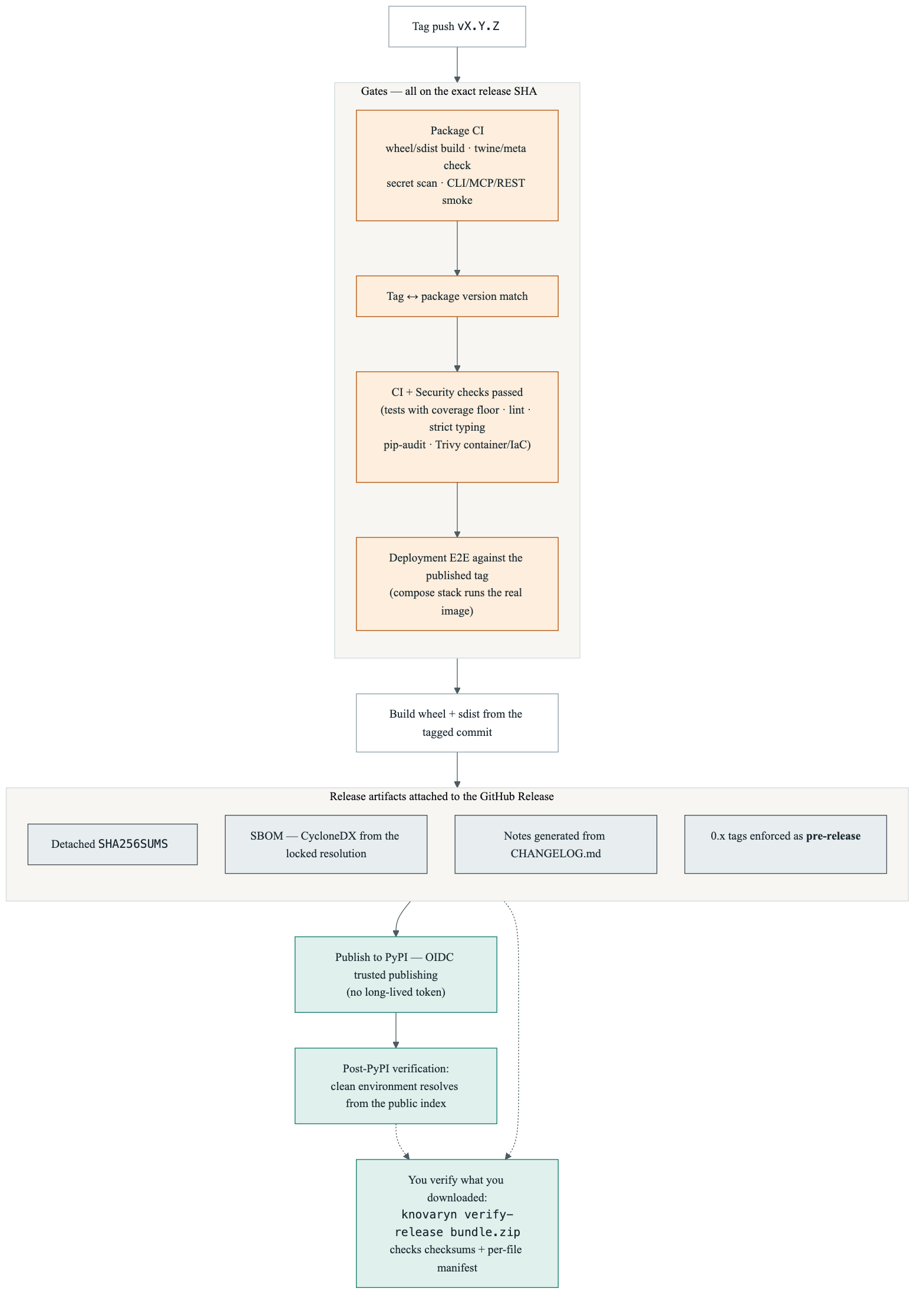
Mirrors .github/workflows/publish.yml: a tag push triggers gates that all
run on the exact release SHA (package CI, tag↔version match, CI + security
checks, deployment E2E against the published tag), then build, artifact
attachment (detached SHA256SUMS, CycloneDX SBOM, changelog notes, 0.x
prerelease enforcement), OIDC trusted publishing to PyPI, post-publish
verification from a clean environment — and finally your own
knovaryn verify-release on the bundle you downloaded.
Mermaid source · Full-size PNG
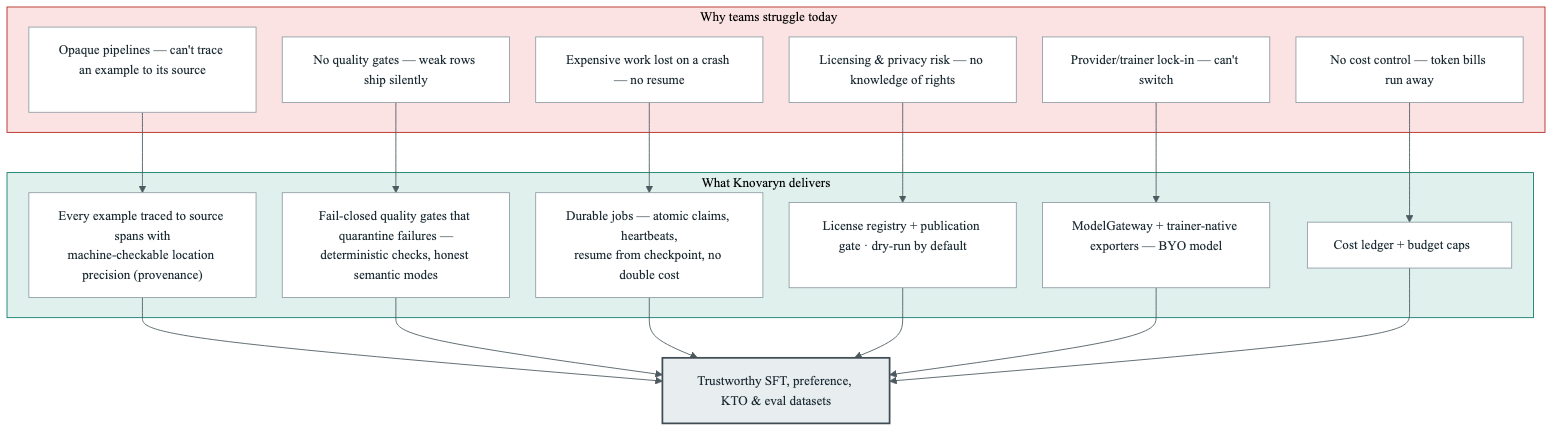
9. Why it's useful — problem → value
Six problems teams hit with ad-hoc synthetic-data pipelines, each paired with the mechanism Knovaryn ships instead, converging on the actual product: trustworthy SFT, preference, KTO, and evaluation datasets.
Mermaid source · Full-size PNG
Regenerating
python scripts/render_diagrams.py
renders every source in docs/assets/diagrams/ (plus
docs/assets/pipeline-flow.mmd) to PNG with the pinned mermaid CLI. The
render is deterministic for a given source and toolchain; commit sources and
renders together.