Concepts — Provenance and the Canonical Data Model
Provenance is the reason Knovaryn exists. Every accepted training example can be walked backward, hop by hop, to the source spans of a permitted source document — at whatever location precision the parser actually recorded (page/bounding-box for Docling-parsed PDFs, section/chunk for markdown or plain text). This page defines the canonical chain and the fields that make it enforceable.
The provenance chain
SourceDocument
   └─(parsed by Docling)──▶ ParsedDocument
        └─spans──────────▶ SourceSpan (page, section, element, char range, quoted text)
             └─grouped───▶ Chunk (structure-aware: heading path, table/list, tokens)
                  └─fed──▶ GenerationCandidate (per topology)
                       └─▶ TrainingExample (evidence refs + content hash)
                            └─(accepted)──▶ DatasetVersion
                                 └─(export)─▶ trainer artifacts

Example → candidate → chunk → parsed doc → source doc → original page/section
Each hop is persisted as its own entity with stable identifiers, so the chain is walkable and verifiable, not decorative.
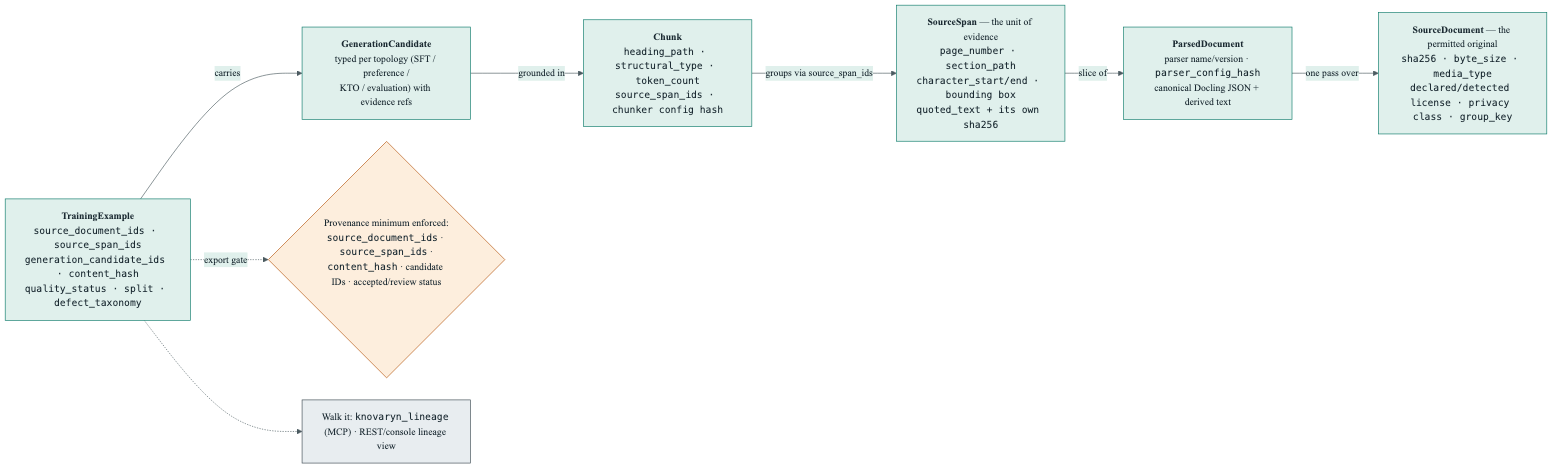
The rendered chain above is generated from
docs/assets/provenance-lineage.mmd;
knovaryn lineage walks it for any example you select.
Entities and the evidence contract
- SourceDocument — the permitted original. Records
sha256,byte_size,media_type,source_kind(upload | local_path | url | repository | dataset),source_locator_redacted,declared_license/detected_license,license_status(allowed | review | blocked | unknown),privacy_classification,group_key(for source-group splits), andintake_status. - ParsedDocument — one parsing pass, keyed to its source. Records the
parser name/version, a
parser_config_hash, and artifact IDs: canonical Docling JSON, derived markdown/text, and diagnostics. Explicitly does not claim error-free extraction. - SourceSpan — a precise slice:
page_number,section_path,element_reference,character_start/end, bounding boxes, andquoted_textwith its ownsha256. This is the unit of evidence. - Chunk — a structure-aware grouping of spans:
heading_path,page_start/end,structural_type(text | table | list | ...),token_count,rendered_context,source_span_ids, and chunker name/version/config hash. Tables and lists stay together by default. - GenerationCandidate — the raw generator output before validation, typed
per topology (SFT, preference, KTO, evaluation) with its own
evidencerefs. - TrainingExample — the validated, canonical row. Carries
source_document_ids,source_span_ids,generation_candidate_ids,content_hash,quality_status,quality_score,quality_dimensions,defect_taxonomy, split assignment,trainer_visible_metadata, andprivate_audit_metadata(kept out of public exports unless enabled). - DatasetVersion — a frozen snapshot with semantic version, parent link, and artifact IDs for the manifest, quality report, dataset card, source manifest, license report, and privacy report.
External handles
Externally visible handles are UUIDv7 (sortable, cryptographically strong);
sequential database IDs are never exposed. Handles are namespaced with a prefix
(job_…, project_…, example_…). Raw secrets (leases, confirmations) use
cryptographic random tokens, never sequential or guessable values.
The provenance minimum (enforced)
An exportable example must satisfy a provenance minimum — the policy checks that the following are non-empty and reviewable:
source_document_idssource_span_ids(whenquality.require_evidenceis true, the default)content_hashgeneration_candidate_ids- a
quality_statusthat isacceptedorreview
If any of these are missing, the example is not exportable, regardless of its quality score. This is a gate in the domain policy, not a convention.
knovaryn:// and content integrity
Resources are addressable as knovaryn:// URIs (e.g.
knovaryn://projects/{id}/...). Content is integrity-protected: rows reference
committed artifact hashes, artifacts are written blob-before-manifest so a
crash never leaves a dangling reference, and a repair command reconciles
orphaned rows/objects.
Splits respect source groups
Split assignment uses grouped random by default on group_key (e.g. by
source document), so a document does not leak fragments across train and
validation/test. The split (train/validation/test, default 80/10/10, seed
42) is part of the plan and recorded per example.