Guides — Your First Real Project¶
The quickstart runs on the deterministic fake provider. This guide walks a
real project: real permitted documents, a local model provider, and the
full review/version/export loop. It assumes a local OpenAI-compatible endpoint
(such as Ollama or a local vLLM) is running on http://127.0.0.1:8080/v1.
The same flow works with a hosted provider; a local one just keeps keys off the machine and makes cost introspection concrete.
1. Configure the provider via environment¶
Providers are wired through configuration and environment (prefix KNOVARYN_).
Point the gateway at your local endpoint:
export KNOVARYN_DEEPSEEK_BASE_URL="http://127.0.0.1:8080/v1"   # OpenAI-compatible
export KNOVARYN_GENERATOR_MODEL="your-gen-model"
export KNOVARYN_CRITIC_MODEL="your-critic-model"
export KNOVARYN_VERIFIER_MODEL="your-verifier-model"
Because models.* default to ${KNOVARYN_...} placeholders, setting these env
vars is enough. Check the wiring:
uv run knovaryn doctor
2. Create the project¶
uv run knovaryn project create support-config \
  --name "Support-Config Dataset" \
  --description "SFT + preference from internal runbooks (company-permitted)"
Use the printed project handle (proj_…) below as <proj_handle>.
3. Add documents with declared licenses¶
Add each file you are permitted to use, declaring the license:
uv run knovaryn source add <proj_handle> ./docs/runbook-a.pdf --license internal --privacy internal
uv run knovaryn source add <proj_handle> ./docs/runbook-b.md  --license internal --privacy internal
uv run knovaryn source list <proj_handle>
source list shows the ingested sources with their preflight: SHA-256, size,
license status, privacy classification. If a license is blocked or
unknown, content is gated from public export but (per policy) can still be
used for a non-public path.
4. Estimate before you spend¶
The dry-run cost estimate is exposed over MCP (knovaryn_estimate_run)
and REST before anything is generated. On the CLI, go straight to run and
set a hard spend cap:
uv run knovaryn run \
  --project <proj_handle> \
  --target 800 \
  --budget-usd 50
Generation is now real and billable (tokens against a live model); keep
budget.maximum_cost_usd (default 50.0 in domain/config.py) aligned with
your intent.
5. Watch progress¶
uv run knovaryn job list --project <proj_handle>
uv run knovaryn job status <job_handle>
Jobs are durable: leases, heartbeats, checkpoints, idempotency keys, and a provider-call dedup cache. Interrupting a run and retrying resumes from the persisted checkpoint instead of redoing paid work; actual versus estimated cost is recorded per job so spend stays auditable.
6. Review with evidence¶
Example handles (ex_…) appear in validation output and in the REST/MCP
listings. Record decisions as immutable revisions:
uv run knovaryn review <ex_handle> approve --reviewer alice --note "grounded"
uv run knovaryn review <ex_handle> reject --reviewer alice \
  --note "grounding<0.9"
Examples that failed policy already landed in quarantine with reason codes and are excluded from export. Human review refines the remainder; every decision is recorded as a new revision — nothing is mutated in place.
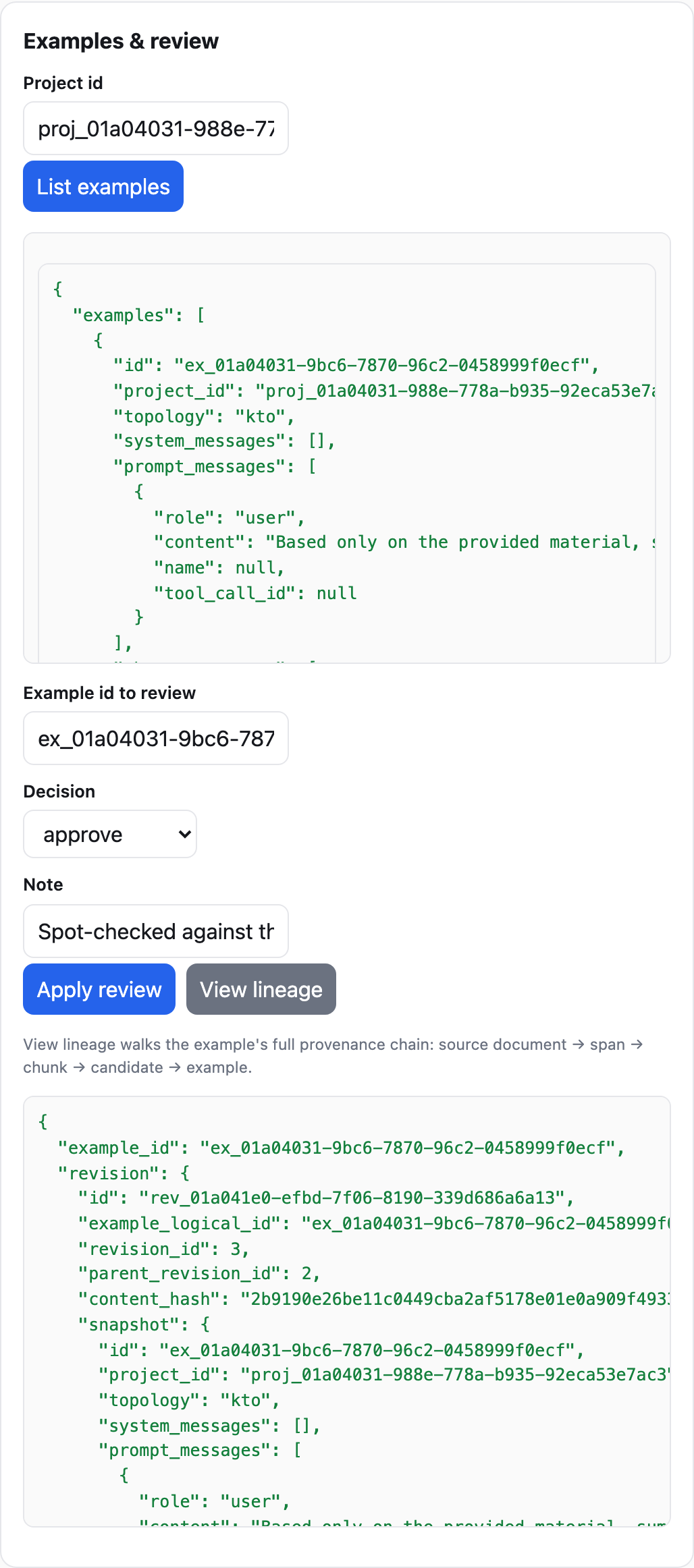 The same review applied from the console: a new immutable revision (2, parent 1) records the decision.
7. Version and export¶
uv run knovaryn dataset validate <proj_handle>
uv run knovaryn dataset version <proj_handle> --set 1.0.0
uv run knovaryn dataset export <proj_handle> \
  --version <ver_handle> --format trl_sft --out ./export/sft
uv run knovaryn dataset export <proj_handle> \
  --version <ver_handle> --format parquet --out ./export/parquet
dataset validate re-checks provenance minimums and quality gates before
versioning; format ids are the generated table in the
exporter reference.
8. Inspect lineage¶
Lineage is served over REST
(GET /v1/projects/{id}/examples/{eid}/lineage) and MCP (knovaryn_lineage),
returning the full walk example → generation candidate → chunk → parsed
document → source document, with each span's machine-reported location
precision. The exported release bundle includes the dataset card, manifest,
and reports.
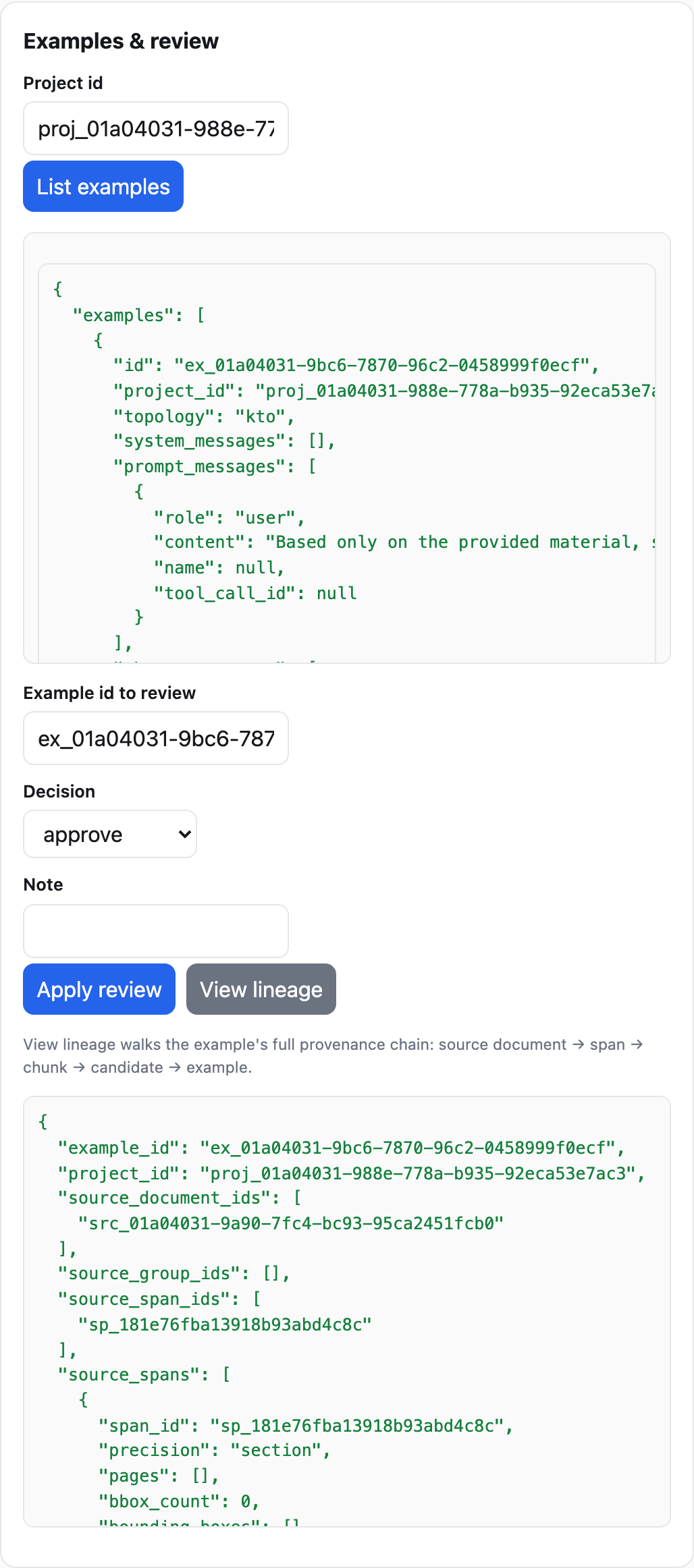 The same lineage in the web console (§6–8 of this guide, driven through the browser).
Notes and honesty¶
- Quality scores are relative to your configured policy and corpus. A row that passes is not a guarantee it improves your model.
- The local endpoint must actually accept the OpenAI-compatible chat schema;
knovaryn doctorsurface-tests wiring but not model quality. - Real runs bill against your provider; keep the budget cap set.