Deployment — Profiles
Knovaryn ships with built-in profiles that shift the default configuration
for a given operating context. A profile is selected with the profile: config
key (or the KNOVARYN_PROFILE environment variable); knovaryn run also takes
--profile as a per-invocation override. The profile influences providers,
quality floors, storage, and security posture.
| Profile | Intent | Provider | Storage | Notes |
|---|---|---|---|---|
offline-demo |
Credential-free demo | fake (deterministic) | SQLite + local | No keys, no network; tolerant on quality to keep the demo flowing. |
fast-local |
Fast local iteration | local OpenAI-compatible / fake | SQLite + local | Lower target counts, faster chunks. |
balanced |
Default | fake / local / hosted | SQLite (or PG) | Balanced cost/quality. |
high-quality |
Stricter quality | hosted | SQLite / PG + S3 | Raises floors, more review, higher budget. |
air-gapped |
No network at all | fake / local | SQLite + local | Everything local; no provider egress, telemetry off. |
enterprise |
Governed team | hosted via gateway | PostgreSQL + S3 | Scope-based auth, admin policy enforced, heavier audit/retention. |
The profiles move the same application core between scales — configuration, not a fork:
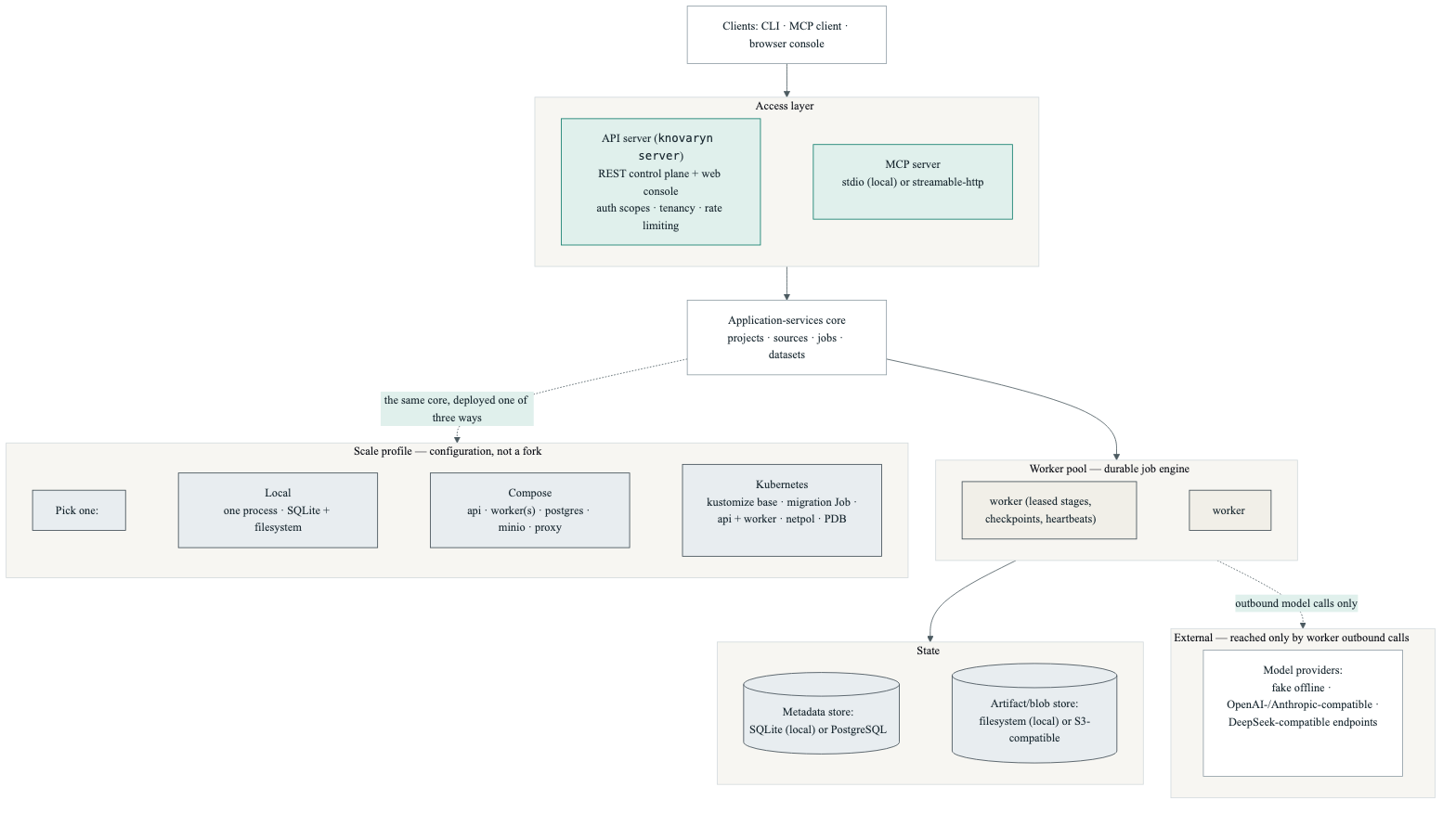
The laptop profile
KNOVARYN_PROFILE=offline-demo uv run knovaryn mcp   # quick start
uv run knovaryn run --project <p> --profile fast-local
Laptop deployments are SQLite + local CAS on .knovaryn/. No services to
run; knovaryn doctor confirms the environment. Best for the offline demo,
experimentation, and single-user production against a local model.
The team profile
KNOVARYN_PROFILE=enterprise uv run knovaryn mcp
Team deployments move storage up the stack:
- Database: PostgreSQL (
storage.database_url→postgresql+asyncpg://...). - Artifacts: S3-compatible store (
storage.artifact_backend: s3). - Identity: OAuth-style resource scopes and admin-enforced policy.
The change is configuration, not code (ADR 0006): the same ArtifactStore
and repository ports back SQLite + local CAS or PostgreSQL + S3.
The air-gapped profile
KNOVARYN_PROFILE=air-gapped uv run knovaryn mcp
For environments with no network:
- Uses the deterministic fake provider or a strictly local model.
- Telemetry/OpenTelemetry disabled and provider egress blocked by policy.
- Everything stays on local storage; no URL ingestion.
Air-gapped is about where you point it, not a separate binary — the same adapters are used, but network-exposed ones are disabled.
Profile knobs you can tune
Profiles are starting points. You can override any value in a project or user
config file without weakening admin-enforced protected keys. Run
knovaryn doctor after editing to confirm the environment resolved as
expected.
Choosing
- Just trying it →
offline-demo. - Local work with a real model →
fast-localorbalanced. - Regulated / strict QA →
high-quality(and your own quality policy). - Forbidden to touch the network →
air-gapped. - Multi-user governed team →
enterprise(see Docker).